By Joshua Pratchard, VP of Operations, East Bay Glass
When people watch a crew set a large sheet of glass high on a building, they watch the glass. After three decades in this trade, I watch everything else: the crane, the rigging, the street, the pedestrians, and the plan that put us there. On a large-format glass replacement, the glass is the easy part. The planning is the job.
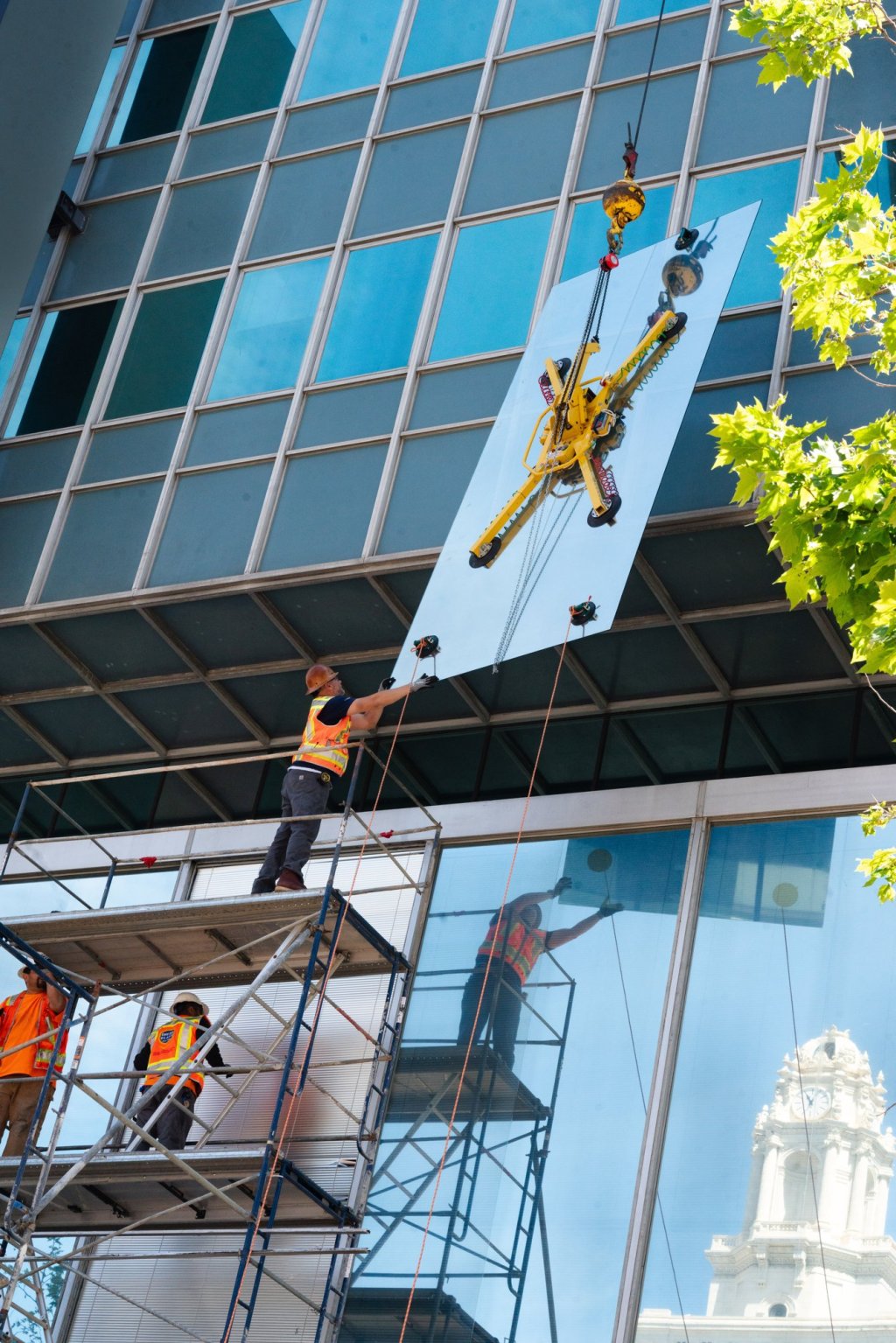
What follows is drawn from projects I have led at East Bay Glass, including a crane-set curtain wall replacement on Broadway in downtown Oakland, an overnight glass lift at Oakland International Airport, and telehandler sets at KTVU Fox 2 and a downtown Walgreens.
1. Select the right equipment for the site
Every site dictates its equipment. A high-rise on a busy street may call for a crane. A tight courtyard, like the one at KTVU, may accommodate only a telehandler and scissor lifts. A plaza storefront may be best served by a telehandler that can reach over planters and railings. The equipment decision drives everything that follows: setup footprint, ground conditions, reach, capacity, and how much of the street or site must be controlled.
2. Develop the pick plan before anyone touches the glass
A pick plan defines exactly how each lift will be executed: the weight of the panel and rigging, the crane or telehandler configuration, the lift path, the route the load will travel, and each person’s role. We rig large panels with a quad-cup vacuum lifter and chain falls so the glass can be controlled and positioned precisely at the opening. All of it must be accounted for before the first panel leaves the ground.
3. Control the street and protect the public
On Broadway, the lift was only part of the job. We needed engineered traffic control plans to close two lanes, including the AC Transit bus lane, and to route vehicles and buses safely around the work zone. At the Walgreens plaza, it meant fencing off the work area and directing pedestrians around each lift. Keeping the public safe and moving is part of doing the work correctly.
4. Understand who has authority over the site
Every project answers to someone beyond the client. Downtown, that means the city and the transit agency. At Oakland International Airport, it was the FAA. Any crane operating at an airport requires FAA review, so I prepared and secured the FAA permits, along with the crane pick plan and a detailed site safety plan, and we scheduled the work overnight to stay clear of airport operations.
5. Write the safety plan for the worst moment of the day
A good safety plan is more than paperwork. It addresses what happens if the wind picks up, if the vacuum lifter loses pressure, or if someone enters the work zone. The crew must know the plan, the signals, and who has the authority to stop the lift. The Marine Corps taught me that preparation is what allows a team to remain calm under pressure, and that applies on a jobsite as much as anywhere.
The bottom line
Anyone can order a sheet of glass. What owners and general contractors are paying for is a team that can install it safely, on schedule, and without closing a building, a street, or an airport longer than necessary. That comes down to planning.
Joshua (Josh) Pratchard is Vice President of Operations at East Bay Glass in Oakland, a U.S. Marine Corps veteran, and a journeyman glazier. More of his work is on the Projects page.


Leave a comment